
The Poisoning Case and Its Silence
We Have Always Lived in the CastleThis flow traces how the poisoning remains present through Julian’s account, village stigma, Charles’s avoidance, and the sisters’ final refusal to reopen it.
increasing Bearing strength in each event
 decreasing
Bearing strength in each eventdecreasingThe Dinner Recalled
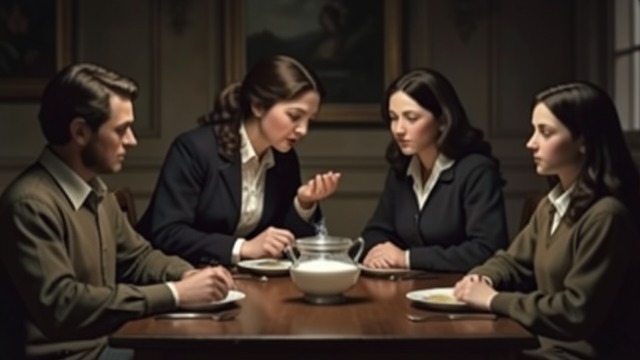
The Dinner Recalled
A case made social
Julian recounts the family dinner in which several relatives died after eating poisoned sugar. Mrs. Wright’s curiosity draws the guests into details the polite visit was supposed to avoid.
The sisters’ composure
Constance and Mary Katherine listen while Julian performs his account. They appear amused by the visitors’ discomfort, even as the story concerns their own family.
The poisoning is both a private catastrophe and a public story. The tea party shows how easily outsiders turn the sisters’ loss into entertainment and investigation.
The Unanswered Motive

The Unanswered Motive
Questions about the sugar
Mrs. Wright asks why Constance might have used arsenic and focuses on the cleaned sugar bowl, the purchase of poison, and the missing explanation. Julian supplies details but cannot settle the motive.
Ambiguity preserved
Constance gives brief answers and does not explain the crime. Mary Katherine observes the discussion without correcting the guests’ assumptions.
The case remains unresolved in the social imagination because explanation is desired but withheld. The uncertainty becomes a condition the family lives inside rather than a mystery the novel neatly closes.
The Trial’s Long Shadow

The Trial’s Long Shadow
Public scrutiny remembered
Mary Katherine recalls the visitors who once came to stare at Constance and take souvenirs. She remembers being sent away while the trial proceeded and waiting for her sister to return.
Different burdens
Constance became the accused person in public view, while Mary Katherine was left outside the courtroom and largely unseen. The sisters carry different memories of the same aftermath.
The trial’s end did not end its social consequences. It established a lasting pattern in which Constance is watched and Mary Katherine is treated as an unsettling shadow.
Charles Refuses the Past

Charles Refuses the Past
A demand for silence
Julian asks Charles to describe the family’s behavior during the trial so he can improve his manuscript. Charles says the event should be forgotten and refuses to discuss it.
Competing forms of control
Julian sees the refusal as an attack on his work; Charles presents silence as a healthier path for Constance. Their dispute makes the family history an immediate struggle rather than a settled past.
Neither man speaks for the sisters without consequence. Charles’s wish to close the subject risks erasing Julian’s record, while Julian’s narration keeps painful memories active.
A Boundary Around the Secret

A Boundary Around the Secret
The truth acknowledged
After the fire and Julian’s death, Constance tells Mary Katherine that she knows who poisoned the family. Mary Katherine confirms that she put the poison in the sugar.
A renewed silence
Constance says they will never discuss the act again. Mary Katherine asks her not to remind her, and the conversation ends in an affirmation of love.
The admission settles responsibility between the sisters without resolving its meaning. Their silence becomes an intimate boundary, distinct from the public explanations that outsiders have sought for years.
During Helen Clarke’s tea visit
Later in the same tea visit
In Mary Katherine’s memories before Charles arrives
At Charles’s first breakfast
After the sisters refuse the doctor’s visit
